Student Accommodation in UK: A Complete Guide
Finding suitable student accommodation in the UK is one of the most important steps for international students planning to study abroad. Your accommodation is not simply a place to sleep; it becomes your home, study environment and social space throughout your university journey.
For international students arriving in the UK for the first time, choosing where to live can feel confusing. There are several options, including university halls of residence, private student accommodation, shared houses, private rooms and homestays. Each option has different costs, facilities, contracts and advantages.
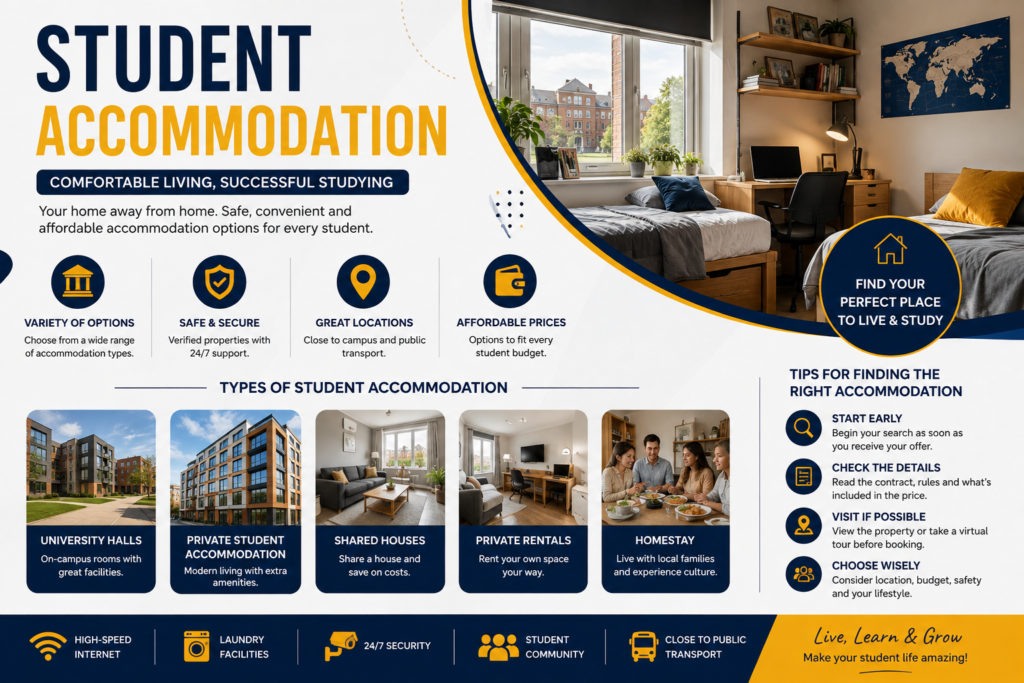
The good news is that UK universities and colleges usually have accommodation teams that can help students understand their options. The British Council recommends starting your accommodation search as soon as you accept your university offer because popular university accommodation can fill up quickly.
This guide explains the main types of student accommodation in UK, their advantages and disadvantages, expected costs, important documents and practical tips for international students.
Why Is Student Accommodation Important?
Choosing the right accommodation can have a major impact on your university experience.
Good accommodation can provide:
- A comfortable place to live
- A suitable environment for studying
- Easy access to your university
- Opportunities to meet other students
- Better control over your monthly budget
- Access to essential facilities
- A sense of security and independence
For international students, accommodation can be particularly important because moving to another country involves adapting to a new culture, education system and lifestyle.
Living close to campus can also reduce commuting time and transportation expenses.
Types of Student Accommodation in UK
There are several types of accommodation available to university students.
1. University Halls of Residence
University halls are one of the most popular accommodation options, particularly for first-year students.
These residences are owned or managed by universities and are usually located on or near campus.
A typical room may include:
- Single bedroom
- Bed and study desk
- Wardrobe
- Shared or private bathroom
- Shared kitchen
- Common areas
- Internet access
Some halls offer en-suite rooms, while others have shared bathrooms.
According to Study UK, university accommodation can range from rooms with shared kitchens and living areas to self-contained studios. Some halls are catered, while others are self-catered.
Advantages of University Halls
- Close to campus
- Easy to meet other students
- Often furnished
- University support available
- Convenient for new international students
- Sometimes bills are included
Disadvantages
- Limited availability
- Some rooms may have shared bathrooms
- Less privacy than a private studio
- Accommodation rules may apply
2. Private Student Accommodation
Private student accommodation, sometimes called purpose-built student accommodation (PBSA), is another popular option.
These properties are designed specifically for students and are usually operated by private companies.
Facilities can include:
- Private bedrooms
- En-suite bathrooms
- Shared kitchens
- Study rooms
- Gyms
- Common rooms
- Laundry facilities
- Wi-Fi
- Security systems
- Social spaces
Private student accommodation can be attractive to international students who want modern facilities and a student-focused environment.
However, prices can vary significantly depending on the city, location and facilities.
3. Private Rented Accommodation
Another option is renting a house or apartment from a private landlord.
Students often choose this option after their first year when they have already made friends and can share a property with other students.
Private accommodation can provide more independence and flexibility. You may be able to choose the location, number of bedrooms and people you want to live with.
However, students need to understand their tenancy agreement and responsibilities before signing a contract.
UK government guidance explains that students may rent directly from a private landlord or live in halls or private halls, and the legal arrangements can differ depending on the type of accommodation.
4. Shared Student Houses
Sharing a house with other students is a common way to reduce accommodation costs.
For example, five students might rent a house together and share:
- Kitchen
- Living room
- Bathroom
- Utility bills
- Internet
- Other household expenses
Each student normally has their own bedroom.
The biggest advantage is that sharing can be cheaper than renting a private studio. It can also create a social environment where students can build friendships.
However, sharing requires cooperation. Students need to agree about cleaning, bills, food, noise and other household responsibilities.
5. Homestay Accommodation
A homestay means living with a local UK family in their home.
This option can be particularly useful for international students who want to experience British culture and improve their English communication skills.
Depending on the arrangement, the host family may provide:
- Private bedroom
- Meals
- Shared living areas
- Internet
- Household facilities
The British Council notes that homestay accommodation can provide international students with an opportunity to experience UK culture directly.
Homestay can be a good option for younger students or those who prefer a family-style environment.
Student Accommodation Costs in UK
The cost of student accommodation in UK depends on several factors.
The biggest factors include:
- City
- University location
- Room type
- Private or university accommodation
- Distance from campus
- Facilities
- Contract duration
- Whether bills are included
London is generally more expensive than many other UK cities, while cities outside London may offer more affordable options.
Students should not compare accommodation based only on the advertised rent. Always check whether the price includes:
- Electricity
- Gas
- Water
- Heating
- Wi-Fi
- Insurance
- Other service charges
An accommodation option with a slightly higher rent may sometimes provide better value if several bills are already included.
How to Find Student Accommodation in UK
International students should begin searching for accommodation as early as possible.
A simple process is:
Step 1: Check Your University
Visit your university’s official accommodation page after receiving an offer.
Check:
- Available halls
- Application deadlines
- Room types
- Prices
- Location
- Facilities
- Eligibility requirements
Some universities have accommodation specifically for international students, but availability varies between institutions.
Step 2: Compare Different Options
Do not immediately accept the first accommodation you find.
Compare at least several options based on:
- Total cost
- Location
- Room size
- Facilities
- Contract length
- Transport
- Reviews
- Security
Step 3: Check the Contract
Read the agreement carefully before paying money.
Look for information about:
- Rent
- Deposit
- Contract length
- Cancellation
- Notice period
- Bills
- Repairs
- Guests
- Rules
- Moving-out requirements
Step 4: Confirm What Is Included
Ask the accommodation provider exactly what is included in the rent.
This can prevent unexpected expenses later.
Student Accommodation for International Students
International students often face additional challenges when renting accommodation.
One common issue is a UK guarantor.
A guarantor is someone who agrees to pay the rent if the tenant fails to pay. UCAS notes that many private accommodation providers require a UK-based financial guarantor. Some companies offer guarantor services for students who do not have someone in the UK who can act as a guarantor.
International students may also be asked for additional documentation.
Depending on the accommodation, you may need:
- Passport
- University offer or student ID
- Visa information
- Proof of income or funds
- Guarantor information
- References
- Deposit
Requirements vary, so students should confirm them before applying.
Student Accommodation Deposit
A deposit is money paid to protect the landlord or accommodation provider against certain losses, such as unpaid rent or damage.
Deposit rules depend on the type of accommodation and location.
For example, current England guidance states that for relevant private tenancies, a tenancy deposit can generally be up to 5 weeks’ rent when annual rent is below £50,000, or up to 6 weeks’ rent when annual rent is £50,000 or more.
There can also be a holding deposit, which is used to reserve a property. In England, current government guidance states that a holding deposit can be up to one week’s rent.
Students should always keep receipts and records of payments.
Important: Housing rules can differ across England, Scotland, Wales and Northern Ireland, so students should check the rules applicable to their accommodation.
What Should Students Look for in Accommodation?
Before choosing student housing, consider the following factors.
Location
Choose accommodation that provides convenient access to your university.
A cheaper room far away from campus may cost more when transportation expenses are added.
Safety
Check:
- Building security
- Door locks
- Lighting
- Fire safety
- Emergency procedures
- Security staff where applicable
Internet
A reliable internet connection is essential for university students because lectures, assignments, research and communication increasingly depend on online services.
Kitchen Facilities
If you plan to cook your own meals, check the kitchen carefully.
Look for:
- Refrigerator
- Freezer
- Oven
- Microwave
- Cooking space
- Storage
- Washing facilities
Laundry
Check whether washing machines are available inside the building and whether using them costs extra.
Study Environment
Students should consider whether the accommodation provides a quiet environment for studying.
Some modern student residences offer dedicated study rooms.
Cheap Student Accommodation in UK: How to Save Money
Students who are working with a limited budget can take several steps to reduce accommodation expenses.
Choose a Shared Room or House
Sharing a house can reduce rent and utility costs.
Consider Cities Outside London
Accommodation in many cities outside London can be more affordable.
Live Slightly Further From Campus
A property farther from the university may have lower rent, provided transportation remains affordable and convenient.
Compare Bills
Do not compare rent alone. Calculate the total monthly cost including utilities and transportation.
Book Early
Popular accommodation can become unavailable quickly. Starting early gives you more choices.
Ask About Student Discounts
Some accommodation providers offer special rates or promotions for students.
Common Mistakes When Choosing Student Accommodation
International students should avoid these common mistakes.
1. Booking Without Reading the Contract
Never agree to a tenancy without understanding its terms.
2. Paying Money Without Verification
Be careful with accommodation advertisements and online listings. Verify the landlord or accommodation provider before transferring money.
3. Ignoring Transportation Costs
Cheap rent does not necessarily mean cheap living.
4. Not Checking Bills
Find out whether utilities are included.
5. Choosing Only Based on Photos
Online photos may not show the full condition or environment of a property.
6. Waiting Until the Last Minute
Popular university halls and private student properties can become limited as the academic year approaches.
Final Thoughts
Finding the right student accommodation in UK is an important part of preparing for university life. International students can choose from university halls, private student accommodation, shared houses, private rentals and homestays.
There is no single accommodation option that is perfect for everyone. The best choice depends on your budget, university location, privacy preferences, lifestyle and length of study.
University halls can be particularly convenient for new students because they are often close to campus and provide opportunities to meet other students. Private accommodation can offer more flexibility, while homestays can provide a valuable cultural experience.
Before booking, always compare the total cost, read the contract carefully, check what is included in the rent and verify the accommodation provider. If you are an international student, pay particular attention to guarantor and documentation requirements.
Most importantly, start your accommodation search early. Once you have accepted your university offer, contact the university’s accommodation office and research your options. Early planning can give you more choices and help you find a safe, comfortable and affordable place to live during your UK study journey.
Housing laws, tenancy rules, fees and accommodation policies can change. Always check the latest guidance from your university and official UK government sources before signing an agreement or making a payment.