Post-study Work in the UK: A Complete Guide
For many international students, studying at a UK university is not only about earning a degree. It is also an opportunity to gain international work experience, develop professional skills and build a career in a global job market.
The post-study work option in the UK is therefore one of the most important factors students consider when deciding where to study abroad.
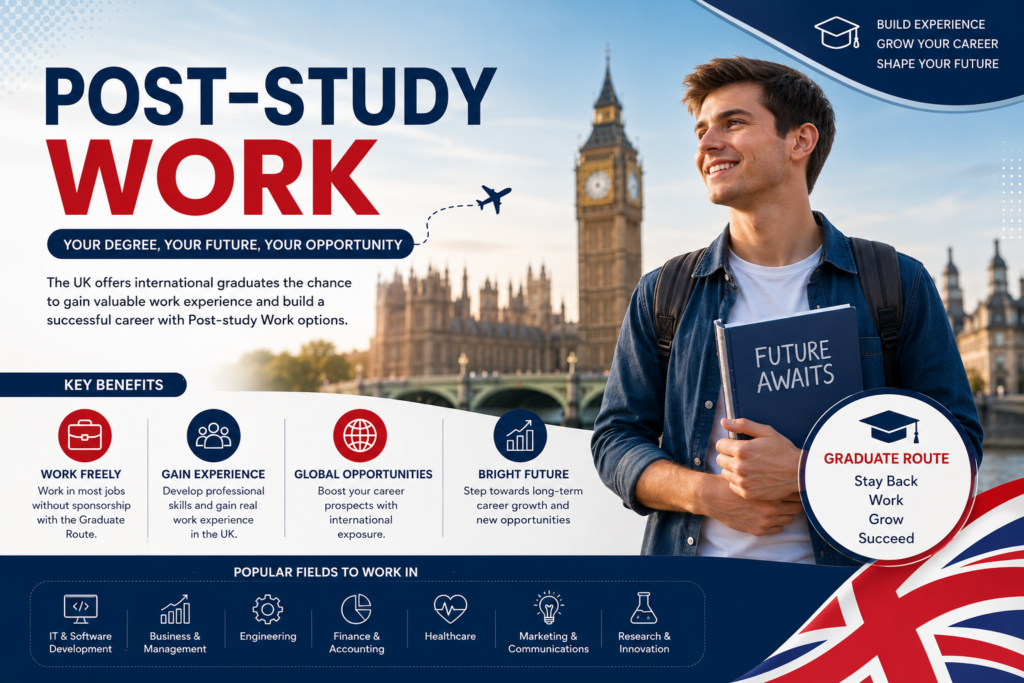
The UK’s main route for eligible international graduates is the Graduate visa, commonly known as the Graduate Route. It allows eligible students who successfully complete an eligible UK course to stay in the country and work or look for work without requiring employer sponsorship at the time of application.
However, UK immigration rules are changing. For applications made on or before 31 December 2026, eligible bachelor’s and master’s graduates can generally receive a Graduate visa for two years. For applications made on or after 1 January 2027, the period for most bachelor’s and master’s graduates will be reduced to 18 months. PhD and other doctoral graduates continue to receive three years.
This guide explains how post-study work in the UK works, who can apply, what graduates can do during the Graduate Route and what options may be available after it ends.
What Is Post-study Work in the UK?
Post-study work refers to the opportunity for an international student to remain in the UK after completing an eligible academic course and gain professional experience.
The UK’s Graduate visa is an unsponsored immigration route. This means graduates do not need an employer to sponsor them when applying for the Graduate visa itself. Eligible graduates can generally work in most jobs, look for employment and even be self-employed.
This gives graduates time to:
- Search for suitable jobs
- Gain UK work experience
- Build professional networks
- Develop industry skills
- Explore career opportunities
- Move toward another eligible work visa
The Graduate Route is particularly useful for students who want to enter the UK job market immediately after university.
How Long Can You Work in the UK After Graduation?
The length of the Graduate visa depends on when you apply and what qualification you have completed.
Bachelor’s and Master’s Graduates
For eligible graduates who apply before 1 January 2027, the Graduate visa generally lasts two years.
For eligible graduates who apply on or after 1 January 2027, the Graduate visa generally lasts 18 months.
PhD Graduates
Students who successfully complete a PhD or another eligible doctoral qualification can receive a Graduate visa for three years.
Because immigration policies can change, students should check the latest GOV.UK guidance before making important decisions about their studies or career plans.
Who Is Eligible for the UK Graduate Visa?
Not every international student automatically qualifies for the Graduate Route.
Generally, applicants must have successfully completed an eligible course in the UK while holding a Student visa or previous Tier 4 student permission.
Eligible qualifications commonly include:
- UK bachelor’s degrees
- UK master’s degrees
- UK PhDs
- Other eligible doctoral qualifications
- Certain law qualifications
- PGCE
- PGDE
- Certain regulated professional qualifications
The course normally needs to have been studied with an eligible higher education provider that has the required compliance status.
Students should not assume that every course automatically qualifies. The eligibility of the course and education provider matters.
How Much of the Course Must Be Studied in the UK?
There is also a UK study requirement.
For courses lasting more than 12 months, students generally need to have studied in the UK for at least 12 months.
For courses shorter than 12 months, they generally need to have studied the full length of the course in the UK.
This is important for international students considering distance learning, overseas study periods or courses with significant time outside the UK.
Before enrolling, students should check whether their planned course will meet the Graduate Route requirements.
What Can You Do on a Graduate Visa?
One of the biggest advantages of the Graduate Route is its flexibility.
A Graduate visa allows eligible graduates to:
- Work in most jobs
- Look for employment
- Work for different employers
- Be self-employed
- Carry out voluntary work
- Travel outside the UK and return
- Continue living in the UK if eligible family members are permitted
The route does not require the graduate to have a sponsored job before applying.
This flexibility can be especially useful for recent graduates who need time to find employment related to their degree.
For example, a computer science graduate might initially work in a junior technology position while searching for a software development role. Similarly, a business graduate could gain experience in marketing, sales, finance or operations while developing a long-term career plan.
What You Cannot Do on a Graduate Visa
Although the Graduate Route is flexible, it does have restrictions.
For example, Graduate visa holders cannot work as professional sportspersons or sports coaches. They also generally cannot access most public funds.
Students should always check the conditions attached to their immigration permission before starting a job or business activity.
Can You Work in Any Job After Graduation?
The Graduate Route provides much more flexibility than a sponsored work route.
Graduates can generally work in most jobs, even if their first job is not directly related to their degree. This can help students gain practical experience while searching for a position that matches their qualifications and long-term career goals.
However, graduates who want to remain in the UK beyond the Graduate Route will normally need to qualify for another immigration route.
This is why students should think about their career strategy before their Graduate visa expires.
What Happens After the Graduate Visa Expires?
The Graduate Route is temporary and is not itself a route to settlement.
One of the most important options for graduates who want to continue working in the UK is the Skilled Worker visa.
To switch to this route, a graduate generally needs:
- An eligible job
- An approved UK employer
- A Certificate of Sponsorship
- A role that meets the relevant occupation requirements
- The required salary
- The required English-language and other eligibility conditions
The Skilled Worker route is different from the Graduate Route because it is based on a sponsored job.
Skilled Worker Visa After Graduation
For many international graduates, moving from the Graduate Route to the Skilled Worker route can be an important long-term career strategy.
Under current rules, the standard Skilled Worker salary requirement is generally the higher of £41,700 per year or the applicable going rate for the occupation, although different rules and salary reductions can apply in specific circumstances.
There are also provisions for certain new entrants and people in particular occupations, so graduates should not assume that £41,700 is the requirement in every individual case.
The job itself must also meet the relevant eligibility rules.
Because salary thresholds, occupation requirements and immigration policies can change, graduates should check the latest Skilled Worker guidance before applying.
How International Students Can Improve Their Chances of Finding a Job
Getting a UK degree does not automatically guarantee employment.
International students can improve their chances by preparing for the UK job market during their studies.
1. Build a Strong CV
Create a clear, professional CV highlighting:
- Education
- Technical skills
- Projects
- Internships
- Work experience
- Certifications
- Achievements
- Relevant extracurricular activities
Keep the CV focused on the job you are applying for.
2. Gain Practical Experience
Employers often value practical skills in addition to academic qualifications.
Students can gain experience through:
- Internships
- Placements
- University projects
- Volunteering
- Part-time work where permitted
- Freelance projects where legally permitted
- Student societies
Practical experience can make a graduate more competitive when applying for entry-level positions.
3. Use University Career Services
Most universities provide career support to students and graduates.
These services may include:
- CV reviews
- Interview preparation
- Career advice
- Employer events
- Job boards
- Networking opportunities
- Career fairs
Students should use these services before graduation rather than waiting until their Graduate visa has already started.
4. Build Professional Connections
Networking can play an important role in finding employment.
Students can attend:
- Career fairs
- Industry events
- University networking sessions
- Employer presentations
- Professional conferences
- Alumni events
LinkedIn can also be useful for connecting with recruiters and professionals in a chosen industry.
Best Career Fields for International Graduates
The best career field depends on the student’s degree, skills, experience and the current UK labour market.
Popular areas among international graduates include:
- Information Technology
- Software Development
- Artificial Intelligence
- Data Science
- Engineering
- Finance
- Accounting
- Business
- Marketing
- Healthcare
- Education
- Research
- Cybersecurity
Students should choose their degree based on academic interests and long-term career goals rather than selecting a course only because they believe it will guarantee a visa or job.
Can You Study While on a Graduate Visa?
Graduate visa holders can study in certain circumstances.
However, there are restrictions. A Graduate visa generally cannot be used to study a course that would meet the relevant Student visa requirements. If the intended course qualifies for a Student visa, the person may need to use the Student route instead.
Students considering another degree should therefore carefully check their immigration options before enrolling.
Can Family Members Stay With a Graduate?
Eligible dependants may be able to remain in the UK with a Graduate visa holder in certain circumstances.
The rules are specific, and not every family member can simply join a Graduate visa holder for the first time.
Students with partners or children should check the current dependant rules before making plans.
When Should You Apply for a Graduate Visa?
Timing is extremely important.
You must apply for the Graduate visa from inside the UK, and your education provider must have reported your successful course completion to the Home Office. You do not necessarily need to have received your physical degree certificate before applying, but the relevant course completion notification must have been made.
A student should therefore:
- Complete the eligible course.
- Wait for the university to report successful completion.
- Check Graduate Route eligibility.
- Prepare the required information.
- Apply while eligible.
- Wait for the decision before making plans based on the new immigration status.
Students should avoid leaving the UK or allowing their current immigration permission to expire without understanding the consequences.
Frequently Asked Questions
How long can international students work in the UK after graduation?
Eligible bachelor’s and master’s graduates can generally receive two years if they apply for the Graduate visa by 31 December 2026. Applications made from 1 January 2027 generally receive 18 months. PhD and other doctoral graduates can receive three years.
Can I work without sponsorship after graduating?
Eligible Graduate visa holders can generally work in most jobs without employer sponsorship during the Graduate Route.
Can I switch from Graduate visa to Skilled Worker visa?
A Graduate visa holder may be able to switch to the Skilled Worker route if they obtain an eligible sponsored job and meet all relevant requirements.
Is the Graduate visa a permanent residency route?
No. The Graduate Route is temporary and is not itself a route to settlement.
Can I be self-employed on a Graduate visa?
Yes, self-employment is generally permitted on the Graduate Route, although professional sportsperson work is not permitted.
Can I apply for the Graduate visa from outside the UK?
No. The Graduate visa application requires you to be in the UK when you apply.