University Comparisons: A Complete Guide for Students
Choosing a university is one of the biggest decisions a student can make. With hundreds of universities and thousands of degree programs available, finding the right option can quickly become confusing. This is especially true for international students who may be comparing universities from another country.
This is where university comparisons become important.
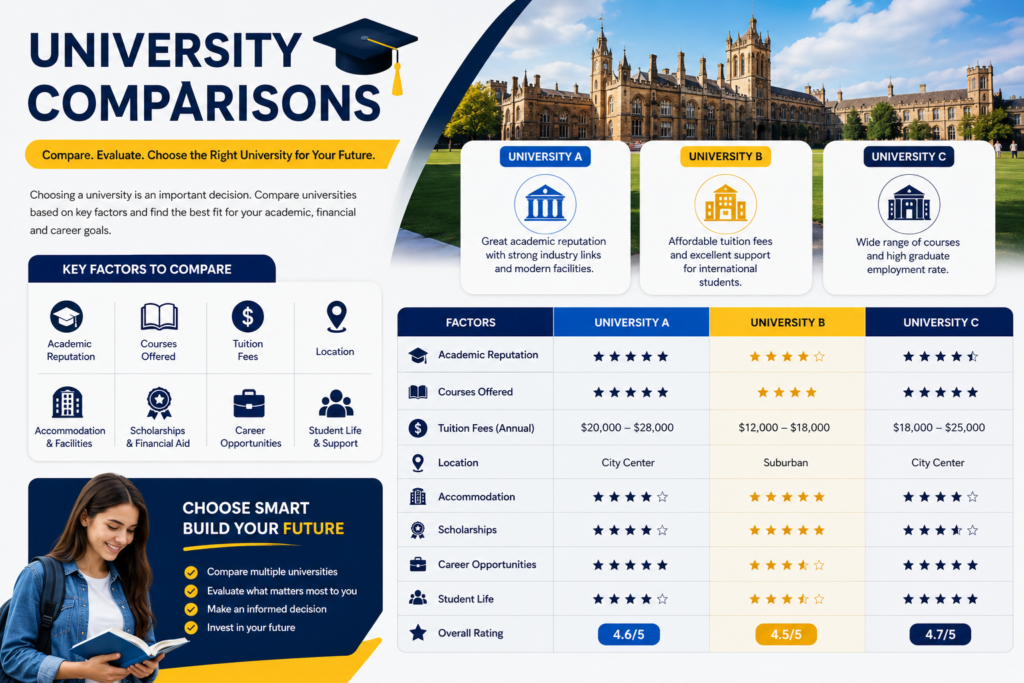
Instead of choosing a university simply because it has a famous name or appears at the top of a ranking, students should compare several factors, including course quality, entry requirements, tuition fees, location, accommodation, student experience, scholarships and career opportunities.
A university that is perfect for one student may not be the right choice for another. The best university is usually the one that matches your academic goals, budget, career plans and preferred lifestyle.
According to UCAS, students should look beyond rankings and consider course content, university location, accommodation, facilities, student societies and career opportunities when comparing universities.
Why Is University Comparison Important?
University comparison helps students make a decision based on facts rather than assumptions.
For example, imagine two universities offer the same degree:
- University A has a higher overall ranking.
- University B has lower tuition fees.
- University A is located in an expensive city.
- University B offers better placement opportunities for your chosen subject.
- University B also has lower accommodation costs.
Which university is better?
There is no universal answer. It depends on the student’s priorities.
This is why comparing universities before applying can help students avoid choosing an institution that looks attractive on paper but does not meet their actual needs.
What Factors Should You Compare?
A useful university comparison should include several important categories.
1. University Rankings
University rankings are one of the first things students usually check.
Rankings can provide information about:
- Academic reputation
- Research performance
- Teaching
- Student experience
- Graduate outcomes
- Subject performance
- International reputation
However, rankings should not be the only factor in your decision.
A university may have an excellent overall ranking but may not be particularly strong in the subject you want to study. UCAS also recommends using rankings as one part of your research rather than making them the sole reason for choosing a university.
Tip:
Always check subject-specific rankings in addition to overall rankings.
For example, if you want to study Computer Science, compare universities based on their Computer Science reputation and course quality rather than their overall position alone.
2. Compare University Courses
Course comparison is arguably more important than university comparison itself.
Two universities may offer a degree with exactly the same title but completely different course structures.
For example, a Computer Science degree at one university might focus on:
- Artificial Intelligence
- Machine Learning
- Data Science
Another university might focus more on:
- Software Engineering
- Web Development
- Cybersecurity
Therefore, students should carefully examine the modules offered by each university.
Check:
- Core modules
- Optional modules
- Practical projects
- Assessment methods
- Exams
- Coursework
- Internships
- Placements
- Research opportunities
- Final-year projects
UCAS specifically recommends checking course modules, teaching methods, assessment styles and tutors when comparing similar courses.
The important question is:
“Which university offers the course content that best matches my career goal?”
3. Compare Tuition Fees
For many students, tuition fees are one of the most important parts of university comparison.
Fees can vary considerably depending on:
- University
- Course
- Degree level
- Student status
- Location
- Subject
International students should be especially careful when comparing fees because international tuition rates can differ significantly between universities and programs.
Do not compare only the advertised tuition fee.
Instead, calculate the total estimated cost of studying.
This may include:
- Tuition fees
- Accommodation
- Food
- Transportation
- Books
- Laptop or equipment
- Visa costs
- Health-related costs
- Insurance where applicable
- Personal expenses
- Travel expenses
A university with slightly higher tuition fees could potentially be more affordable overall if its living costs are much lower.
4. Compare Location
Location can have a major impact on your university experience.
Some students prefer studying in large cities such as London, Manchester or Birmingham, while others may prefer smaller university towns.
When comparing locations, consider:
Cost of Living
Large cities can often have higher accommodation and transportation costs.
Transport
Check how easily you can travel between:
- University
- Accommodation
- Shopping areas
- Train stations
- Airports
- City centers
Lifestyle
Ask yourself whether you prefer:
- Busy city life
- Quiet university towns
- Campus-based living
- Countryside
- Large multicultural communities
UCAS recommends considering the university’s distance from the city centre, countryside and home, as well as accommodation and facilities.
5. Compare Accommodation
Accommodation is often overlooked during university research.
However, where you live can have a major effect on both your budget and student experience.
Compare:
- University halls
- Private student accommodation
- Shared houses
- Private apartments
- Distance from campus
- Monthly rent
- Utility costs
- Internet
- Security
- Shared facilities
For international students, accommodation support can be particularly important because they may not be familiar with the local housing market.
Before accepting an offer, find out whether the university guarantees accommodation for first-year students and what conditions apply.
6. Compare Entry Requirements
Every university and course can have different admission requirements.
These may include:
- Academic grades
- Previous qualifications
- English-language requirements
- Personal statement
- References
- Portfolio
- Interviews
- Entrance tests
For international students, universities may also have specific requirements for different national qualifications.
Do not assume that meeting one university’s requirements means you automatically meet another university’s requirements.
UCAS explains that universities and colleges set their own entry requirements, and these can vary between courses and institutions.
Smart strategy:
Create three categories:
Reach Universities: More competitive than your current academic profile.
Target Universities: Universities where your qualifications closely match the requirements.
Safe Options: Universities where your academic profile is comfortably above the minimum requirements.
This approach can make your university application strategy more balanced.
7. Compare Scholarships and Financial Aid
Scholarships can make a major difference to the total cost of university.
When comparing universities, check whether they offer:
- Merit scholarships
- International student scholarships
- Need-based financial aid
- Subject-specific scholarships
- Research funding
- Sports scholarships
- Government-funded scholarships
Do not only compare the scholarship amount.
Check:
- Eligibility
- Application deadline
- Number of awards
- Renewal conditions
- Required grades
- Whether the scholarship covers tuition or living expenses
A university offering a smaller scholarship may still be more affordable if its overall tuition and living costs are lower.
8. Compare Career Opportunities
University should not only be about earning a degree. Your future career should also influence your decision.
When comparing universities, research:
- Graduate employment
- Career services
- Internship opportunities
- Work placements
- Industry partnerships
- Employer events
- Alumni network
- Professional accreditation
For some degrees, professional accreditation is particularly important.
For example, students studying engineering, medicine, accounting, law or other regulated professions should check whether the course meets the relevant professional requirements.
UCAS recommends considering graduate career prospects and placement opportunities when comparing universities and courses.
9. Compare Student Experience
Academic quality is important, but university life extends beyond lectures.
Look at:
- Student societies
- Sports clubs
- Student unions
- Cultural organizations
- Events
- Libraries
- Gyms
- Study spaces
- Campus facilities
International students should also check whether the university has an active international community.
UCAS recommends international applicants investigate how many international students attend the university and whether there are cultural or social clubs they can join.
A university with a strong student community can make it easier for international students to build friendships and adjust to life abroad.
10. Compare Student Support
Good student support can be extremely valuable, particularly for students moving away from home.
Check whether the university provides:
- Academic support
- Career guidance
- Mental wellbeing services
- International student support
- Disability services
- Financial advice
- Accommodation assistance
- Language support
- Visa-related guidance
Before applying, visit the university’s website and look for its student support services.
You can also read reviews and speak with current students to understand their experiences.
How to Create a University Comparison Table
One of the easiest ways to compare universities is to create a simple spreadsheet.
For example:
| Factor | University A | University B | University C |
|---|---|---|---|
| Course | Excellent | Good | Excellent |
| Ranking | High | Medium | High |
| Tuition Fees | £££ | ££ | £££ |
| Accommodation | Expensive | Affordable | Moderate |
| Location | London | Manchester | Birmingham |
| Scholarships | Good | Excellent | Good |
| Entry Requirements | High | Moderate | High |
| Placements | Excellent | Good | Excellent |
| Student Life | Excellent | Excellent | Good |
| Career Support | Excellent | Good | Excellent |
You can give each category a score from 1 to 10.
For example:
- Course quality = 10%
- Career opportunities = 20%
- Tuition fees = 15%
- Location = 10%
- Scholarships = 10%
- Entry requirements = 10%
- Accommodation = 10%
- Student experience = 10%
- Support services = 5%
The percentages can be changed according to your personal priorities.
This method makes it easier to see which university performs best for your specific needs.
University Rankings vs Course Quality: Which Matters More?
This is one of the most common questions students ask.
The answer depends on your goals.
If you are mainly interested in academic reputation or research, university rankings may be important.
However, if you already know exactly what you want to study, course quality and subject strength may be more important than overall university ranking.
For example, a university ranked lower overall could have an excellent department for your chosen subject.
This is why students should investigate both:
University reputation + Course reputation
rather than relying on only one.
How International Students Can Compare Universities
International students have some additional factors to consider.
Before choosing a university, check:
Academic Requirements
Does your previous qualification meet the university’s requirements?
English Requirements
What English-language evidence is required?
Tuition Fees
Can you afford the full cost of the program?
Scholarships
Are international students eligible for financial support?
Visa
Does the university and course meet the requirements for your intended study route?
Accommodation
Does the university provide suitable housing?
International Community
Are there students from your country or region?
Location
Is the city affordable and suitable for you?
Career Opportunities
What opportunities are available after graduation?
UCAS recommends international applicants research course requirements, international student communities, accommodation, social clubs and university specialisms before making a decision.