Student Visa UK: A Complete Guide for International Students
For international students planning to study at a university or college in the United Kingdom, getting the right visa is one of the most important parts of the process. The UK Student Visa allows eligible international students to study at approved educational institutions in the UK.
The current Student Visa replaced the previous Tier 4 (General) student visa. It is available to students aged 16 or over who have been accepted onto an eligible course by a licensed student sponsor and meet the relevant financial, English-language and immigration requirements.
Applying for a UK Student Visa can seem complicated, especially for students applying for the first time. You may need to arrange university admission, receive a Confirmation of Acceptance for Studies (CAS), prepare financial evidence, prove your identity and complete the online visa application.
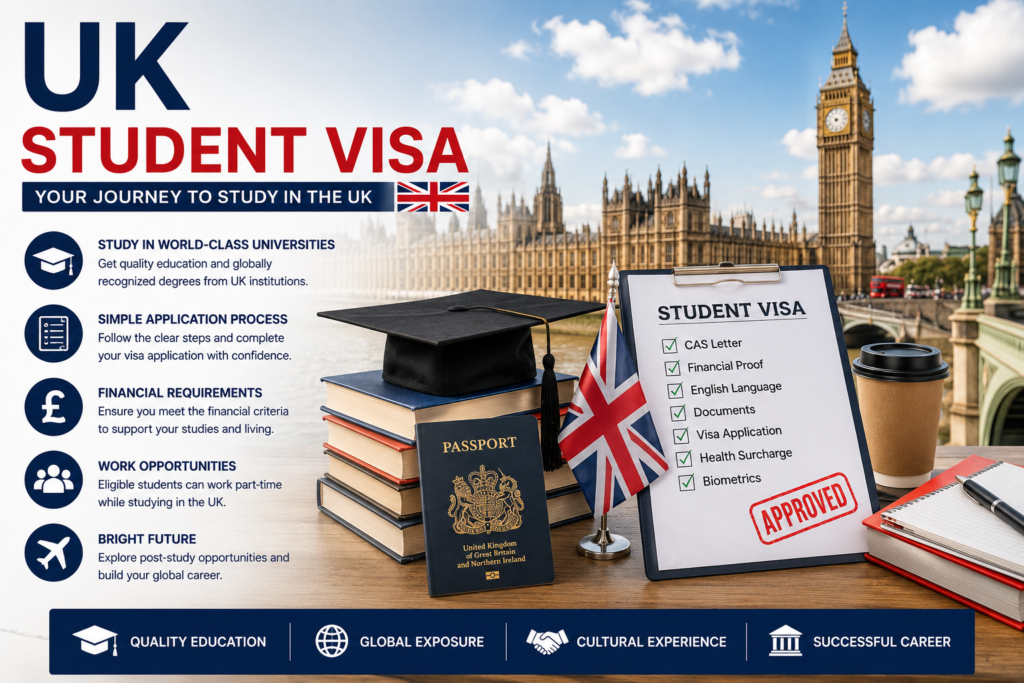
This guide explains the main UK Student Visa requirements, documents, costs, financial rules, application process and post-study options in simple terms.
Important: UK immigration rules, fees and financial requirements can change. The information below reflects the rules available in August 2026. Always verify the latest requirements on GOV.UK before submitting your visa application.
What Is a UK Student Visa?
A UK Student Visa is an immigration permission that allows eligible international students to come to the UK for an approved course of study.
You may be eligible if you are:
- Aged 16 or older
- Accepted onto an eligible course
- Sponsored by a licensed UK education provider
- Able to meet the English-language requirement
- Able to meet the financial requirement when applicable
- Able to provide the required documents and identity information
Your university or education provider must be a licensed student sponsor. Once you receive an unconditional offer and complete the required admission process, the university normally provides a Confirmation of Acceptance for Studies (CAS). You need the CAS before applying for a Student Visa.
If you are under 18 and want to attend an independent school in the UK, a Child Student Visa may be the appropriate route instead.
UK Student Visa Requirements
Before applying, students should make sure they meet all the major requirements.
1. Admission to a UK Institution
The first step is getting accepted by a licensed UK education provider.
Your course must meet the Student Visa rules, and the university or institution must be authorized to sponsor international students.
2. Confirmation of Acceptance for Studies
After you have been accepted and met the relevant conditions, your university provides a CAS reference number.
The CAS contains important information about your course and fees and is required for the Student Visa application. You must apply within six months of receiving your CAS.
3. English Language Requirement
International students generally need to demonstrate that they can speak, read, write and understand English to the required level.
The exact requirement depends on your course and circumstances. Your university may have its own English-language requirements in addition to the immigration rules.
4. Financial Requirement
You may need to prove that you have enough money to pay your outstanding course fees and support yourself while living in the UK.
The required amount depends on where you will study.
5. Identity and Supporting Documents
You must provide a valid passport or other accepted travel document and complete the required identity checks.
Depending on your circumstances, additional documents may be required.
Student Visa Financial Requirements
The financial requirement is one of the most important parts of a UK Student Visa application.
According to current GOV.UK guidance, students normally need enough money to cover their outstanding course fees for one academic year, as shown on their CAS, plus living costs.
For living costs, the current requirement is:
- £1,529 per month for up to nine months if studying in London
- £1,171 per month for up to nine months if studying outside London
This means the maximum living-cost amount normally required for visa purposes is:
London: £13,761 for nine months
Outside London: £10,539 for nine months
These are visa financial requirements, not necessarily the exact amount you will spend. Your actual living expenses can be higher or lower depending on accommodation, lifestyle and location.
Students generally need to have held the required funds for 28 consecutive days, with the end of that period within 31 days of the visa application date, unless an applicable exemption applies.
What Financial Evidence Can You Use?
Depending on your circumstances, acceptable financial evidence can include:
- Your own bank funds
- Certain student loans
- Official financial sponsorship
- Certain funds provided by your parents
- Qualifying sponsorship from an organization or government
Not every type of financial asset is accepted. For example, GOV.UK guidance says that overdrafts, cryptocurrency, stocks and shares and pensions cannot normally be used to meet the financial requirement.
Students should carefully check the official financial evidence rules before preparing their bank statements.
Student Visa Documents Required
The documents required can vary according to your personal circumstances, nationality and course.
Common documents include:
- Valid passport
- Confirmation of Acceptance for Studies (CAS)
- Financial evidence, if required
- English-language evidence, if required
- TB test results, if applicable
- ATAS certificate, if required
- Sponsorship documents, if applicable
- Parental consent for applicants under 18
- Evidence of relationship with a parent or guardian, where required
GOV.UK specifically lists a current passport and CAS among the core documents and notes that additional documents may be required depending on the applicant.
TB Test Requirement
Some applicants need to provide evidence of a tuberculosis test when applying for a UK visa for longer-term study.
Whether you need a TB test depends on your country of residence and other circumstances, so students should check the official GOV.UK requirements before applying.
How Much Does a UK Student Visa Cost?
As of April 2026, the UK Student Visa application fee is £558 for applications made from outside the UK. The same £558 fee applies to applications to extend or switch to a Student Visa from inside the UK.
Students also normally need to pay the Immigration Health Surcharge (IHS) as part of their application. The amount depends on the length of immigration permission granted.
Therefore, students should budget for more than just the visa application fee.
Other potential expenses include:
- University tuition fees
- Accommodation
- Travel expenses
- TB test
- English-language test
- Document preparation
- Transportation to a visa application centre
- Immigration Health Surcharge
- Optional priority visa services, if available
How to Apply for a UK Student Visa
The application process can be divided into several simple stages.
Step 1: Choose a Course and University
Start by selecting an eligible course at a licensed UK student sponsor.
Consider tuition fees, course duration, location, entry requirements and career opportunities before applying.
Step 2: Apply to the University
Submit your university application and provide the required academic and supporting documents.
If the university accepts you, you may initially receive a conditional offer.
Step 3: Meet the Conditions
Complete any remaining requirements, such as providing academic results, English-language evidence or paying a required deposit.
Step 4: Receive Your CAS
After meeting the necessary conditions, the university can issue your CAS.
Check your CAS carefully because important information such as your course details and tuition fees is used in the visa application.
Step 5: Prepare Financial Evidence
If you need to demonstrate funds, make sure your financial evidence meets the current UKVI requirements.
Do not wait until the last moment to prepare your finances because the required funds may need to be maintained for a specific period.
Step 6: Complete the Online Application
The Student Visa application must be completed online. You will need to provide your personal information, passport details, CAS information and other required information.
Step 7: Prove Your Identity
Depending on your nationality and passport, you may either use the UK Immigration: ID Check app or attend a visa application centre to provide biometric information.
Step 8: Wait for the Decision
For applications made outside the UK, the usual processing time is around three weeks. Applications made inside the UK usually take around eight weeks, although processing can take longer in complex cases.
When Should You Apply for a UK Student Visa?
Timing is very important.
If you are applying from outside the UK, you can normally apply up to six months before your course starts.
You should not leave your visa application until the last minute. Although the standard processing time may be three weeks, applications can sometimes take longer because of document verification, additional checks or other circumstances.
A good strategy is to:
- Receive your university offer early.
- Complete all conditions.
- Obtain your CAS.
- Prepare your financial evidence.
- Apply as soon as you are eligible.
- Allow extra time for unexpected delays.
Can Student Visa Holders Work in the UK?
Some international students are permitted to work while studying, but the exact work conditions depend on the type and level of course and the sponsoring institution.
For example, eligible students on a full-time degree-level course at a higher education provider with a track record of compliance can generally work up to 20 hours per week during term time and full-time during vacations. Some other courses have different restrictions.
Students should check the work conditions attached to their visa rather than assuming that every Student Visa holder has identical work rights.
Part-time work can provide valuable experience, but students should not depend on employment as their primary source of funding for tuition and living costs.
Can You Bring Family on a UK Student Visa?
Student Visa dependant rules are now more restricted than they were in the past.
Generally, dependants are only permitted in certain circumstances. For example, eligible full-time students studying a postgraduate course of at least nine months may qualify to bring dependants if the course is a PhD/other doctoral qualification or a research-based higher degree, subject to the immigration rules. Certain government-sponsored students may also qualify.
This is an important area to check before making plans for a spouse or children to join you.
Do not assume that enrolling in any master’s course automatically allows you to bring dependants.
What Happens After Your UK Student Visa Expires?
Your options depend on your circumstances and future plans.
If you successfully complete an eligible course, you may be able to apply for the Graduate Visa.
Current rules provide:
- 2 years for eligible applications made on or before 31 December 2026
- 18 months for eligible applications made on or after 1 January 2027
- 3 years for eligible PhD or other doctoral graduates
The Graduate route can allow eligible graduates to work or look for work in the UK without needing a sponsor under that route.
Because immigration rules can change, students should check the latest Graduate Visa requirements when approaching graduation.
Common UK Student Visa Mistakes to Avoid
A large part of successful visa preparation is avoiding preventable mistakes.
1. Incorrect Financial Evidence
Make sure your funds meet the required amount and holding-period rules.
2. Incorrect Information
All information in your application should be accurate and consistent with your university documents.
3. Ignoring CAS Details
Carefully check your CAS before submitting the application.
4. Applying Too Late
Do not wait until just before your course starts.
5. Assuming Every Course Has the Same Rules
Visa requirements can differ depending on course level, duration and institution.
6. Relying on Outdated Information
UK immigration rules change regularly. Information from an old blog post, social media video or forum may no longer be accurate.
Always verify important information through official GOV.UK guidance.