Intakes & Deadlines in the UK: A Complete Guide
Planning to study in the UK starts long before you submit a university application. One of the most important things international students need to understand is the UK university intakes and deadlines.
Unlike some countries where universities mainly follow one admission period, UK universities may offer courses with different start dates. The availability of each intake depends on the university, degree level and specific course.
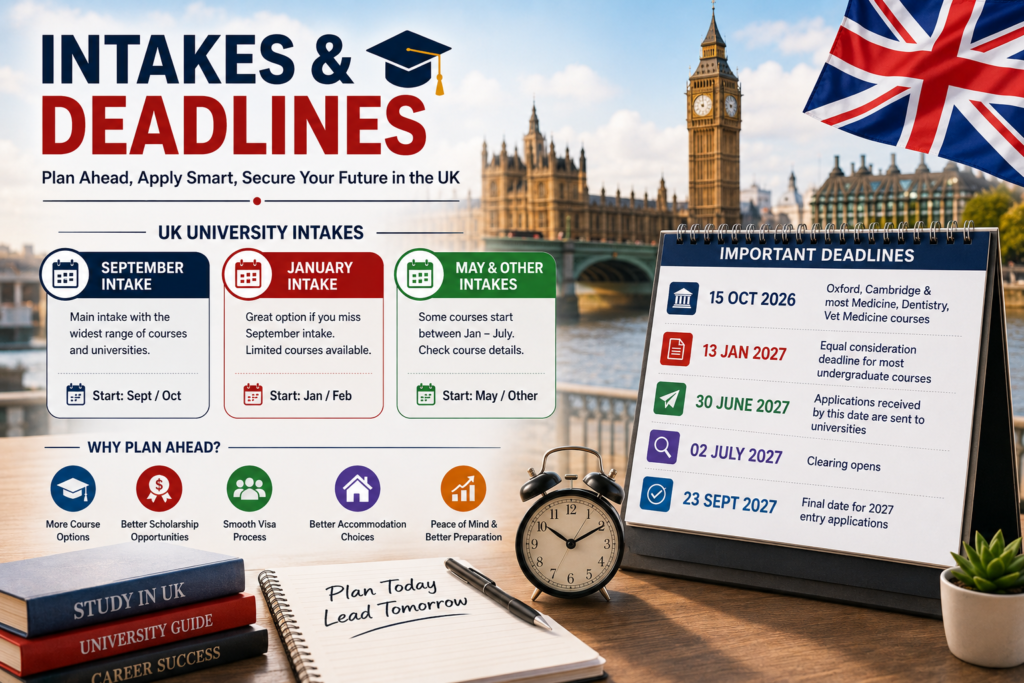
The September or October intake is generally the main intake for UK universities and offers the widest selection of undergraduate and postgraduate programs. Some universities also offer a January intake, while a smaller number of courses may begin between February and July. UCAS confirms that a few courses start between January and July rather than at the typical September/October start, so students should always check the individual course listing.
For international students, understanding these intakes early can make the entire application process easier. It gives you enough time to prepare academic documents, meet English-language requirements, apply for scholarships, receive an offer and complete the visa process.
What Are University Intakes?
A university intake is the period during which a new group of students begins their academic program.
For example, if a university says that a course has a September 2027 intake, students who are accepted for that intake will normally begin their studies around September or October 2027.
The main UK intakes are:
- September/October Intake
- January/February Intake
- Spring or early-year intakes for selected courses
Some universities may advertise additional start dates, but these are not available for every subject.
Therefore, students should never assume that a course is available in every intake. Always check the official university course page before planning an application.
September Intake in the UK
The Main UK University Intake
The September intake is the most important and widely available intake for international students.
It is sometimes called the September/October intake because universities can have slightly different academic calendars.
This intake generally provides the largest number of course choices across undergraduate and postgraduate education.
Why Choose the September Intake?
There are several advantages to applying for September.
More Course Options
Most universities launch their full range of academic programs during the main academic year. Students are therefore more likely to find their preferred course during this intake.
More University Choices
Because September is the main intake, more UK universities are likely to have places available compared with smaller intakes.
Better Scholarship Opportunities
Many university scholarships and external funding opportunities are linked to the main academic cycle. However, scholarship availability varies, so students should check each scholarship individually.
Larger Student Community
The September intake usually brings a large number of new students to campus. This can provide more opportunities to join societies, clubs, events and student activities.
January Intake in the UK
The January intake is another option for international students.
It can be useful for students who miss the September application cycle or need additional time to prepare their academic documents.
However, January intake availability is more limited than September.
Not every university offers every course in January. Some universities may offer selected postgraduate programs, professional courses or specific undergraduate programs.
Advantages of January Intake
A January start may be suitable if:
- You missed the September intake.
- You need additional time to prepare your application.
- Your preferred university offers your course in January.
- You want to avoid waiting until the following September.
- Your academic or personal circumstances make a January start more convenient.
However, students should compare the available courses carefully before choosing January over September.
May and Other UK Intakes
Some UK institutions offer courses with start dates between January and July. However, these are much less common than September and January starts.
UCAS specifically notes that a few courses start between January and July and advises applicants to check the individual course information because earlier start dates can have different deadlines.
This means that the May intake in the UK should not be treated as a standard intake across all universities.
Students interested in a May, April, March or another non-standard intake should search for the exact course and confirm:
- Course start date
- Application deadline
- International student eligibility
- Available seats
- Tuition fee
- Scholarship availability
- Visa timeline
For most students, September remains the safest choice if they want the widest range of UK university options.
UK University Application Deadlines
One of the biggest mistakes students make is confusing the intake date with the application deadline.
They are not the same.
The intake is when your course starts. The deadline is the latest or recommended date by which your application needs to be submitted.
For example:
September 2027 Intake → Application may need to be submitted months earlier.
International students should not wait until the final deadline because they also need time for:
- University decisions
- Conditional offer requirements
- Financial planning
- Scholarship applications
- CAS processing
- Student Visa application
- Accommodation
- Travel arrangements
Therefore, applying early is usually a much better strategy.
UCAS Deadlines for UK Universities
For undergraduate applications, many UK universities use UCAS, the UK’s university application service.
The deadlines depend on the course and entry year.
For 2027 entry, UCAS states that undergraduate applications can be started from May 2026, while completed applications can be submitted from 1 September 2026.
Important 2027 UCAS dates include:
15 October 2026
This is the deadline for applications to the University of Oxford and University of Cambridge, as well as most courses in medicine, dentistry and veterinary medicine/science.
13 January 2027
This is the equal consideration deadline for most undergraduate courses. Applications submitted by this date should receive equal consideration by universities and colleges.
30 June 2027
Applications received by this date are sent to universities and colleges. After this point, new applications are automatically entered into Clearing.
2 July 2027
Clearing opens for eligible applicants, allowing students to search for available university places.
23 September 2027
This is the final date for 2027 entry UCAS applications, according to the current UCAS schedule.
These dates are especially important for undergraduate applicants.
Do International Students Have Different Deadlines?
International students may have more flexibility in some cases.
UCAS explains that many UK universities and colleges continue accepting applications from international students later in the year, closer to the course start date. However, this does not mean students should wait until the last minute.
Popular courses may fill their available places before the final deadline.
For international students, the application process also involves additional steps such as visa preparation and financial documentation.
Therefore, a recommended deadline can be much earlier than the university’s absolute final deadline.
When Should International Students Apply?
A good rule is to start the process at least six months before the intended course start date.
UCAS recommends that international applicants applying for September/October postgraduate courses should submit applications by at least June or July, while also recommending applying around six months in advance where possible.
For a September intake, an international student could use this general timeline:
12–15 Months Before
Research:
- Universities
- Courses
- Entry requirements
- Tuition fees
- Scholarships
- Locations
9–12 Months Before
Prepare:
- Passport
- Academic certificates
- Transcripts
- English-language test
- Personal statement
- References
- CV if required
6–9 Months Before
Submit university applications and scholarship applications.
3–6 Months Before
Receive university decisions, meet offer conditions and prepare financial documents.
2–4 Months Before
Complete the CAS and Student Visa process when eligible.
1–2 Months Before
Arrange:
- Accommodation
- Flights
- Travel insurance if needed
- Banking arrangements
- Essential documents
This timeline gives students a much better chance of avoiding last-minute problems.
September vs January Intake: Which Is Better?
There is no single answer because the best intake depends on your circumstances.
| Factor | September Intake | January Intake |
|---|---|---|
| Course availability | Very high | More limited |
| University choices | More | Fewer |
| Scholarship opportunities | Generally broader | May be more limited |
| Student intake size | Larger | Smaller |
| Application preparation | More planning time | Can be quicker |
| Suitable for | Most students | Students needing an alternative start |
If your preferred course is available in both intakes, compare the university, fees, scholarships and accommodation before deciding.
If the course is only available in September, then waiting for the main intake may be the better option.
What Happens If You Miss a UK University Deadline?
Missing a deadline does not always mean that your study abroad plans are over.
Some universities may continue accepting applications if they still have available places.
UCAS also has Clearing, which can help eligible applicants find available university places later in the application cycle.
However, students should not depend on late applications.
Popular universities and competitive courses may have limited availability, and international students also need enough time to complete visa and travel arrangements.
If you miss a deadline, contact the university directly and ask whether applications are still being accepted for your chosen course.
How to Avoid Missing UK University Deadlines
The best way to manage deadlines is to create a personal application calendar.
Write down:
- University application deadline
- Course start date
- Scholarship deadline
- English test date
- Document preparation deadline
- Offer response deadline
- CAS deadline or expected timeline
- Student Visa timeline
- Accommodation deadline
- Flight planning date
Do not rely only on memory.
You can use a digital calendar or spreadsheet to track every important date.
Also remember that university deadlines can differ from UCAS deadlines, particularly for postgraduate applications and courses with special requirements.
Important Tips for International Students
1. Start Early
Starting early gives you time to compare universities and correct mistakes.
2. Don’t Choose an Intake Only Because It Is Faster
A January or May start may look attractive, but your preferred course may only be available in September.
3. Check the Official Course Page
Always verify the exact start date and deadline for your course.
4. Apply Before the Final Deadline
An early application can give you more time to handle admission, funding and visa requirements.
5. Research Scholarships Early
Some scholarships close before the university’s main application deadline.
6. Keep Visa Timing in Mind
International students need additional time after receiving the necessary university documentation.
7. Keep Backup Options
Consider several universities and courses instead of relying on only one application.