Admission Requirements for UK Universities
Studying at a UK university is a goal for thousands of international students every year. However, before receiving an offer, students need to meet the admission requirements set by their chosen university and course.
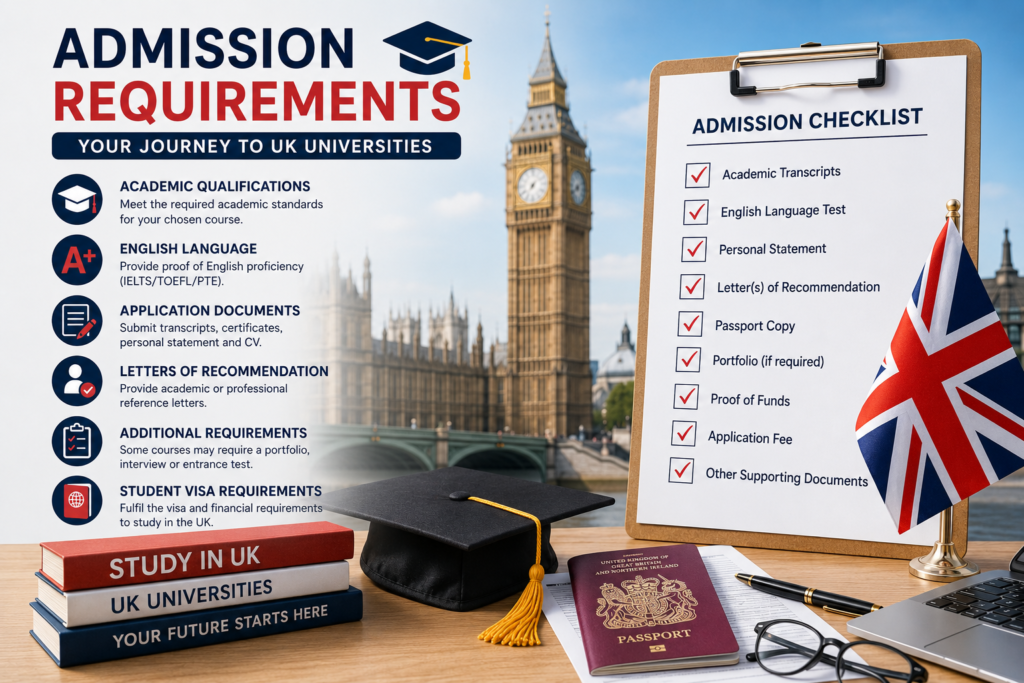
One of the most important things to understand is that there is no single admission requirement for every UK university. Universities and colleges set their own entry requirements, and these can vary according to the university, course, academic level and applicant’s previous qualifications. UCAS confirms that UK course requirements can vary significantly by subject and provider, while international students may use qualifications equivalent to UK qualifications such as A Levels.
For international students, the application process can involve several requirements, including academic qualifications, English-language ability, personal statements, references and supporting documents. After receiving an eligible offer, students who need a visa must also satisfy the relevant UK Student Visa requirements.
This guide explains the major UK university admission requirements for international students and provides a practical roadmap for preparing an application.
What Are Admission Requirements?
Admission requirements are the academic and other conditions a student must meet to be considered for a particular university course.
These requirements may include:
- Previous academic qualifications
- Required grades
- Specific subjects
- English-language proficiency
- Personal statement
- Academic or professional references
- Portfolio
- Interview
- Work experience
- Entrance tests
- Additional course-specific requirements
The exact requirements depend on the course.
For example, a university may require strong mathematics qualifications for an Engineering or Computer Science degree, while an Art and Design course may require a portfolio.
Therefore, students should always check the official course page rather than assuming that the requirements are the same across all UK universities.
Academic Requirements for UK Universities
Academic qualifications are usually the first major requirement considered by universities.
Universities normally specify the qualification level and grades expected from applicants. UK universities commonly describe undergraduate requirements using UK qualifications such as A Levels, but international applicants can normally be considered using equivalent qualifications.
For example, an undergraduate course may specify requirements such as:
- A Levels
- International Baccalaureate
- Equivalent national qualifications
- Foundation qualifications
- Specific subject grades
The required grades can vary significantly between universities and courses.
Why Your Subjects Matter
Getting the required overall grades may not always be enough.
Some courses require students to have studied particular subjects.
For example:
Engineering: Mathematics and Physics may be important.
Computer Science: Mathematics or another relevant subject may be required by some universities.
Medicine: Chemistry and other science subjects may be required.
Business: Mathematics, Economics or Business Studies may be useful or required for certain programs.
Art and Design: A portfolio may be an important part of the application.
Always check the individual course requirements before applying.
Undergraduate Admission Requirements
Students applying for a bachelor’s degree generally need to demonstrate that they have completed an appropriate secondary or post-secondary qualification.
Common requirements may include:
- High school qualification
- Relevant subjects
- Required grades
- English-language proficiency
- Personal statement
- Academic reference
- Additional admissions test for certain courses
- Portfolio for selected subjects
International students should understand that their country’s educational qualification may not be listed exactly as they expect on a UK university website.
This does not necessarily mean they are not eligible.
Universities often assess international qualifications against their own entry standards. UCAS explains that international applicants can use equivalent qualifications they have already completed or are currently studying toward.
Postgraduate Admission Requirements
Students applying for a master’s degree generally need a relevant bachelor’s degree or an equivalent qualification.
However, requirements differ considerably between programs.
A postgraduate application may require:
- Bachelor’s degree
- Minimum GPA or classification
- Relevant academic background
- English-language proficiency
- Personal statement
- Academic references
- CV
- Work experience for certain programs
- Research proposal for some research degrees
- Portfolio for creative subjects
Some master’s programs are open to graduates from different academic backgrounds, while others require a closely related bachelor’s degree.
For example, a master’s in Data Science may require previous study in computer science, mathematics, statistics or a related discipline.
English Language Requirements
English-language proficiency is one of the most important admission requirements for international students.
Universities need to make sure students can understand lectures, complete written assignments, participate in discussions and communicate effectively.
The exact English requirement depends on the university and course.
Universities may accept different forms of evidence, including approved English-language tests or previous education taught in English, depending on their own policies.
For UK Student Visa purposes, the government generally requires English at CEFR B2 for degree-level study or above and B1 for study below degree level, although the way the requirement is assessed can depend on the student’s circumstances and sponsor.
Common English Tests
Depending on the university, students may encounter requirements involving tests such as:
- IELTS
- PTE Academic
- TOEFL
- Other accepted English qualifications
The required score can differ between universities and courses.
Some courses may require higher scores in particular components such as writing or speaking.
Important: Do not assume that the same English score is accepted for every university. Always check the official course page before booking a test.
Personal Statement
A personal statement can be an important part of a university application, particularly for undergraduate applications.
It should explain why you are interested in the subject and demonstrate that you are prepared for university-level study.
A strong personal statement should focus on:
- Your interest in the chosen subject
- Academic experiences
- Relevant skills
- Projects or activities
- Career ambitions
- Relevant work or volunteering experience
- Why you are prepared for the course
Students should avoid simply listing achievements.
Instead, explain what you learned from your experiences and how they relate to the course.
The goal is to show the university that you have genuine academic interest and have thought carefully about your chosen subject.
Academic References
Some UK university applications require references from people who can comment on the applicant’s academic ability, character or suitability for higher education.
For undergraduate applications, a reference may commonly come from a teacher, adviser or another suitable person who knows the applicant academically.
Postgraduate applicants may be asked for academic or professional references depending on the course.
A good reference should provide useful information about the applicant rather than simply repeating information already included in the application.
Students should check the exact reference requirements of their chosen application route and university.
Required Documents for UK University Admission
Preparing documents early can make the application process much easier.
Depending on the university and course, international students may need:
- Valid passport
- Academic certificates
- Academic transcripts
- English-language test result
- Personal statement
- Reference letters
- CV
- Portfolio
- Research proposal
- Work experience evidence
- Financial documents where requested
- Certified translations where required
Documents that are not in English may need to be translated according to the university’s requirements.
Students should keep both digital and physical copies of important academic documents.
Portfolio Requirements
A portfolio is particularly important for certain creative and practical subjects.
Programs that may request a portfolio include:
- Graphic Design
- Fine Art
- Fashion Design
- Architecture
- Photography
- Illustration
- Animation
- Film
- Interior Design
The portfolio requirements can vary significantly.
One university might ask for a specific number of projects, while another may focus more on the applicant’s creative process.
A strong portfolio should demonstrate:
- Creativity
- Technical ability
- Original thinking
- Development of ideas
- Problem-solving
- Consistency
- Understanding of the chosen subject
Always read the portfolio instructions provided by the university.
Interviews and Entrance Tests
Not every UK university course requires an interview, but some competitive programs may use interviews or additional assessments.
Depending on the course, applicants may need to complete:
- University interviews
- Subject-specific tests
- Admissions assessments
- Auditions
- Portfolio reviews
- Practical assessments
Medicine, dentistry, law, performing arts and certain highly competitive programs may have additional selection stages.
If an interview is required, students should research the course carefully and be prepared to explain their academic interests, experiences and reasons for choosing the subject.
Work Experience Requirements
Work experience is not required for every university course.
However, it can be important for certain professional programs.
For example, relevant experience may be valuable for courses related to:
- Medicine
- Nursing
- Social Work
- Education
- Business
- Healthcare
- Professional practice
Some postgraduate programs may also expect applicants to have professional experience.
Students should carefully distinguish between required experience and recommended experience. If a university says experience is preferred rather than mandatory, applicants should not automatically assume that they are ineligible without it.
Admission Requirements for International Students
International applicants need to consider an additional layer of requirements because their educational qualifications may differ from UK qualifications.
The university may assess:
- Country of education
- Previous qualification
- Grade equivalency
- Subjects studied
- English proficiency
- Academic progression
Students should search the university website for international qualification information or contact the admissions team if their qualification is not clearly listed.
This is especially important when applying from countries where the education system differs significantly from the UK.
UK Student Visa Requirements After Admission
University admission requirements and UK Student Visa requirements are not the same thing.
First, the student needs to be accepted by an eligible institution and receive the necessary confirmation for visa purposes. For a Student Visa, the student needs a Confirmation of Acceptance for Studies (CAS) from their course provider. GOV.UK states that students need a CAS before applying for the Student Visa.
Depending on the applicant’s circumstances, visa documentation may include:
- Current passport
- CAS
- Financial evidence
- English-language evidence where applicable
- TB test certificate where required
- ATAS certificate where required
- Sponsorship evidence where applicable
- Parental consent for certain applicants under 18
GOV.UK lists the passport and CAS as core Student Visa documents and notes that additional evidence may be required depending on the applicant.
Financial Requirements for a UK Student Visa
International students should distinguish between university tuition requirements and Student Visa financial requirements.
For the current Student Visa financial requirement, students generally need to show funds for their course fees and living costs unless an exemption applies.
The current maintenance requirement is £1,529 per month for up to nine months in London and £1,171 per month for up to nine months outside London. The funds generally need to have been held for the required period, including 28 consecutive days, under the relevant rules.
Because immigration requirements can change, applicants should verify the latest figures immediately before submitting their visa application.